

SaaS companies have a specific, painful relationship with search competition. The categories they compete in — project management software, CRM platforms, HR tools, accounting systems — are among the most aggressively contested search territories on the internet. Every player in the space is producing content, building links, and competing for the same small set of high-intent keywords that drive trial signups.
The result is a search landscape where the top 3 positions are locked up by companies that have spent years building authority, content production budgets are enormous, and marginal improvements in keyword rankings require disproportionate investment. Traditional SEO, even done well, delivers incrementally diminishing returns in these environments.
Quantum SEO for SaaS is designed for exactly this context — high competition, defined buyer personas, complex content ecosystems, and a need to drive very specific types of conversions (trials, demos, freemium signups) rather than just traffic.
Why High-Competition SaaS Categories Are Hard to Crack
The difficulty isn’t just about competition volume. It’s structural.
SaaS search competition creates what you might call authority moats: companies like HubSpot, Salesforce, and Asana have spent years building massive content libraries, earning thousands of high-quality backlinks, and establishing entity authority that Google’s systems deeply associate with their respective categories. Trying to outrank them for head terms with traditional SEO is genuinely futile for most competitors — the authority gap is too large to close in any reasonable time horizon.
The typical response is to compete in the long tail — finding lower-competition keywords where authority moats are less deep. This is a reasonable partial strategy, but it has its own ceiling: long-tail keywords in SaaS typically have high relevance to specific buyer intents, but individually low volume. Even ranking for dozens of them produces modest traffic gains.
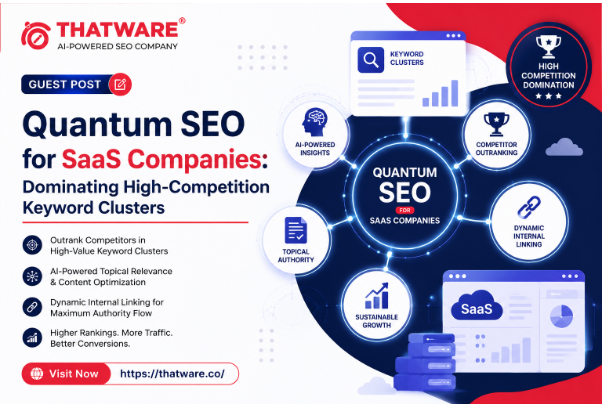
The quantum SEO alternative is different. Rather than competing for individual keywords (whether head terms or long tail), it focuses on building topical authority cluster dominance — owning entire semantic territories within a category, rather than individual keywords within it.
Topical Authority Clusters: The Strategic Foundation
The central concept in Quantum SEO services for SaaS is the topical authority cluster — a comprehensive, semantically interconnected content ecosystem built around a specific sub-topic within your category.
A SaaS company doesn’t need to outrank HubSpot for “CRM software.” But it might realistically achieve comprehensive authority in a specific cluster — say, “CRM for construction companies” — if it systematically builds the right content ecosystem around that cluster.
What “systematically” means in a quantum SEO context:
Full semantic coverage — Not just the obvious content (a page about CRM for construction companies) but comprehensive coverage of the full intent distribution: implementation guides, ROI calculation tools, comparison content between relevant alternatives, industry-specific use case articles, integration guides for construction-specific tools, and FAQ content addressing specific pain points.
Entity authority within the cluster — Clear associations between your brand and the relevant entities in this semantic space: specific construction company types, relevant software integrations, industry associations, regulatory bodies, and key figures. This entity mapping makes it much clearer to search engines that your site is a genuine authority in this specific intersection.
Internal authority concentration — A dense internal link structure that connects all cluster content back to a central pillar page, creating the topical authority hub that concentrates ranking power for the cluster.
External authority signals — Targeted link acquisition from sources within the semantic cluster: construction industry publications, software review sites that cover construction tech, and integration partner content.
Mapping the Buyer Journey Across the Search Funnel
SaaS buyers have complex, multi-stage journeys. They move from problem awareness to category discovery to solution evaluation to vendor comparison to purchase decision — and at each stage, they’re searching differently.
Quantum SEO for SaaS maps the full semantic field of each stage of this journey for each topical cluster and ensures comprehensive content coverage across all stages, not just the bottom-of-funnel transactional content most SaaS companies prioritize.
Awareness stage — Searches focused on problems and outcomes (“how to reduce project management overhead,” “why CRM implementations fail”) before the buyer even knows they’re looking for software. Content targeting this stage builds early brand association with problem-relevant queries.
Discovery stage — Searches focused on solution categories (“best project management tools,” “what is CRM software”) as buyers begin researching options. Category-level content positions your site as an authoritative resource before competitive evaluation begins.
Evaluation stage — Searches focused on comparison and selection criteria (“Asana vs Monday comparison,” “CRM features checklist,” “project management software pricing”) during active vendor evaluation. Comprehensive comparison and evaluation content that honestly serves buyer needs — even when competitors are mentioned — builds trust and captures research-stage traffic.
Decision stage — High-intent searches by buyers close to purchase (“Asana free trial,” “[your software name] demo,” “enterprise CRM implementation cost”). These are easier to capture once upper-funnel authority has been established.
The Competitive Intelligence Layer
Enterprise Quantum SEO optimization for SaaS companies includes a sophisticated competitive intelligence capability that goes beyond standard keyword gap analysis.
Quantum-inspired competitive intelligence models the semantic territory each competitor occupies — not just which keywords they rank for, but which topical authority clusters they’ve built, which entity associations they’ve established, and where the gaps in their semantic coverage exist.
These gaps are strategic opportunities. If a leading competitor has comprehensive coverage of your category’s head terms but sparse coverage of a specific industry vertical, that’s an opening to build cluster authority that the competitor’s authority moat doesn’t protect.
The intelligence layer maps these opportunities continuously — tracking how competitors’ semantic territories are evolving, which new cluster areas they’re expanding into, and where opportunities are opening up or closing as the competitive landscape shifts.
Content Velocity and Quality Balance
A common SaaS SEO mistake is treating content volume as the solution to authority gaps. More content, faster publishing, larger team. This produces diminishing returns because volume without quality or semantic coherence doesn’t accumulate topical authority effectively — it just produces more thin content.
Quantum SEO for SaaS optimizes for semantic velocity — the rate at which each piece of content contributes to topical authority accumulation in its target cluster. High-semantic-velocity content is:
-
Comprehensively covering its topic (not leaving obvious related questions unanswered)
-
Clearly entity-annotated (search engines can clearly identify what it’s about)
-
Well-integrated into the cluster’s internal link structure (topically connected rather than isolated)
-
Semantically differentiated from similar content already in the cluster (not redundant)
A SaaS company producing 4 high-semantic-velocity pieces per month in a priority cluster will outperform one producing 20 thin, poorly-integrated pieces in terms of topical authority accumulation — and do so with significantly less content production overhead.
Conversion Architecture Alignment
All the organic traffic in the world doesn’t help a SaaS company if it’s driving awareness-stage visitors to bottom-of-funnel conversion pages. Quantum SEO for SaaS explicitly aligns content architecture with conversion architecture — ensuring that each cluster has appropriate conversion pathways calibrated to the buyer intent stage it serves.
Awareness content converts to email capture and top-of-funnel nurture. Discovery content converts to trial registrations and demo requests. Evaluation content converts to comparison tools, ROI calculators, and sales-assisted evaluations. Decision content converts directly to trial, purchase, or sales contact.
This conversion architecture isn’t an afterthought applied to content after it’s created. It’s designed into the content cluster structure from the start, ensuring that organic traffic is channeled through appropriately matched conversion paths at each stage of the buyer journey.
The result, for SaaS companies that implement this systematically, is not just more organic traffic — it’s fundamentally better-qualified organic traffic that converts at higher rates and generates better pipeline quality than general-keyword-targeted content strategies can produce.